Sacrificing the Elk; How Tabletoppers Use Repair to Explain a Game
In 1993, Richard Garfield revolutionized the gaming industry when he created Magic: The Gathering (MTG). This card game pits players against each other, attacking and countering each other using the words on the cards they place on the table (https://www.museumofplay.org/toys/magic-the-gathering/). The game is a ripe situation for studying shared norms and rules, conversational discourse, and cultural groups spawned between friends. To define this group, the researcher uses the term “Tabletoppers”. Specifically, it will refer to individuals who often play board games, card games, or role-playing games with a fantasy theme, typically with complex rules.
Literature Review
No study could be found on board games specifically, but there are many linguistics studies done on repair. A study done on the show Modern Family, conducted by Okazawa, sought to discover how fictional characters use other-repair with regards to implicit membership categorization. They found that fictional characters use repair for comedic purposes or to distinguish personalities. They also argued that fictional discourse can imply how we use language to construct identities, and how repair can be a way to show when confusion happens between conflicting identities (Okazawa, 2025). In another study, repair was studied in children and adults. Karmiloff-Smith and their team of researchers asked participants to identify repairs based on narrative provided to them, then again with a structured interview, with a focus on how the brain develops language. Their study noted that pronouns were identified the quickest and noted that “Repairs turn out to be a natural unit of analysis for metalinguistic exploration of the discourse-level properties of language” (Karmiloff- Smith et al., 1993;586). In a study more similar to the methodology of this one, Clayman and Raymond looked into the particle you know as “an adjunct to repair” (80). They were specifically concerned with same-turn repair in this corpora study, and used transcripts(?) from the late 60s-late 90s. They found that people did not use other-repair as much. They also discovered that individuals used you know in self-repair, identifying issues in speech, and to receive feedback from conversation partners (Clayman and Raymond, 2021). As stated previously, no study was found to be conducted on board or card games, which makes this study strikingly different from other studies. Similar to the Okazawa study, this one takes a unique situation and analyzes the speech patterns given the game’s context.
Data
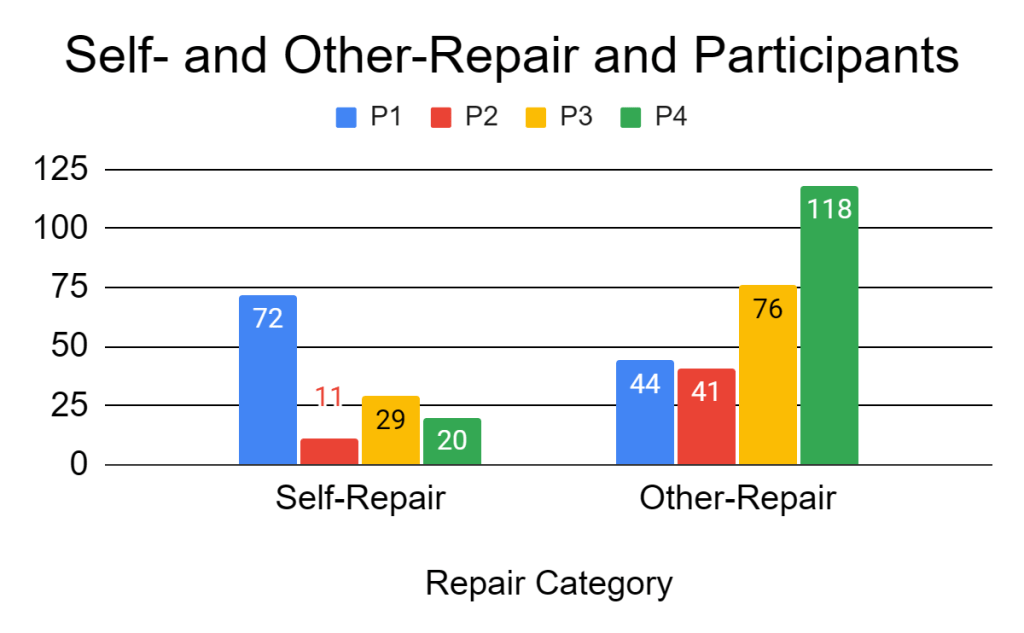
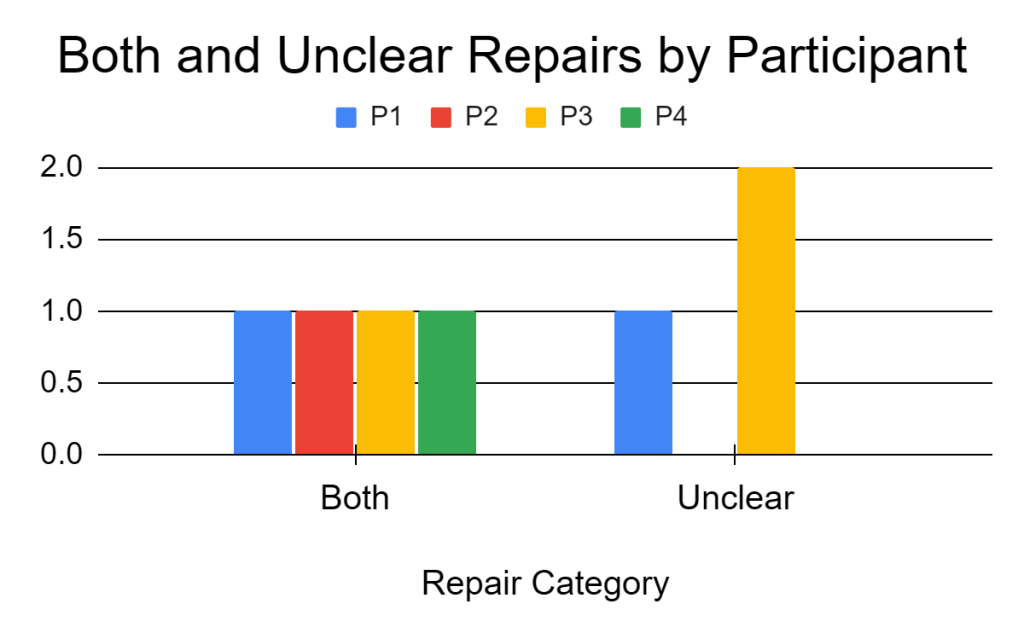
As can be seen in Figure 1, other-repair was the largest category with 279 repairs. Of the other-repair category, Participant 4 had the highest amount, and of the self-repair category, Participant 1 had the highest amount. Participant 2, who spoke the least out of every participant, also had the least amount of each category (besides the Both category where every participant had an instance of such and the unclear category where Participant 4 also had none).
Figure 1: Total from Repair Category Made in the Game
It can be found in Figure 2 the exact numbers of each repair reason. The largest repair reason group was the Clarification section with 259 instances and the smallest (besides the Duotype category) was Transitional with 8 total instances. For the Clarification and Confusion reasons, Participant 4 had the highest amount. For Elaboration, Social, and Transitional reasons, Participant 1 had the most. Participant 2 had the least amount of Clarification and Confusion reasons, and Participant 3 had no Transitional reasons resulting in him being the lowest in this group.
Figure 2: Repairs Made Over the Course of the Game

Analysis
A timeline of the repairs made throughout the game can be found in Figure 3. There are many areas of the timeline that repairs clumped together. Participant 4 was the most experienced player and she talked the most, second was Participant 1 (the least experienced) as she was asking questions and gaining information. Participant 3 spoke a decent amount as well, but not quite as much as the previously mentioned players. Participant 2 spoke the least possibly due to not being experienced, but ve also did not need as much help in the game. Ve could also be more introverted than the other participants, or simply allowed the other tabletoppers to explain instead.
There were larger gaps between repairs in the beginning, more repair clumps after the 1:15:00 mark, and less repair after around the 1:25:00 mark. These milestones exist during the main gameplay stage: pre-game preparation lasted from the beginning of the game until 0:20:50, main-stage gameplay lasted from then until 2:05:47 (when the first player, Participant 3, was eliminated), and the end of the game (final three players in the game) lasted from then until the end of the audio clip. The final player eliminated before the end of the game, Participant 1, happened at the time stamp 2:22:36, two and a half minutes before the conclusion of the game. The game resulted in Participant 4 winning.
Figure 3: Repairs Made Over the Course of the Game

The Numbers
The data clearly identifies Clarification as being the main reason for using repair, which confirms this portion of the hypothesis. As stated previously, other-repair was used the most and therefore provided more striking information about how repair is used in the context of a game: it seems that corrections and clarifying previous statements were used the most. This made the first hypothesis invalid.
 Teague McElroy's Digital Portfolio